







Electrostatic Deflection Electron Gun Assemblies
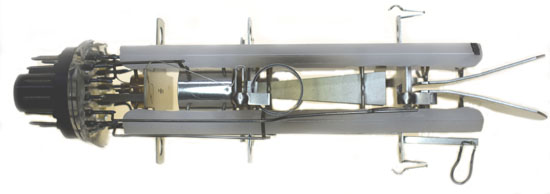
Oscilloscope: The picture bellow is of a gun from a digital storage oscilloscope. Early digital storage oscilloscopes used the same CRTs with the signal being captured and stored in memory, then reproducing the signal to drive the Y-plates. This particular CRT had a problem of current leakage between the deflection plates and the final anode. It appears that a getter was over-fired during manufacture. Part of the metal ring has evaporated, coating the glass supports with metal. A leakage path between one of the x-deflection plates and the anode was created. The metal shading on the supports behind the getter ring is just visible in the image. The Y-plates are where the electrons leave the gun heading to the screen.
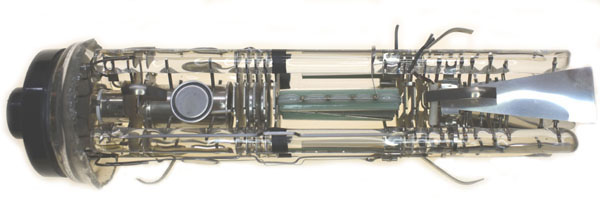
The gun on the right is from a Tektronix analogue storage oscilloscope. The tube contains a secondary set of guns known as flood guns which are used to preserve the image written by the main gun on the screen which had a conductive film as well as the fluorescent coating. This was the method required to store trace
images on the screen before digital oscilloscopes. One interesting point is the image could remain after switching the scope off and on.
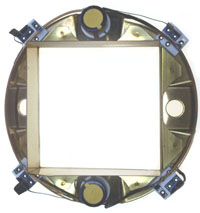
The flood guns are shown on the right. There are two heaters, cathodes, and anode gun assemblies mounted top and bottom onto the metal support which was fitted to the tube cone just in front of the main gun assembly. Electrons from the gun pass through the square aperture on the metal frame. The flood guns are arranged to
cover either the top or bottom trace and preserve the image of one or other or both. This Tektronix CRT had a ceramic cone where the flood gun wiring was connected. The cone was bonded to the face plate glass and the glass neck housing the electron gun. X and Y plate connection pins were around the glass tube neck.
Below is a large World War 2 radar electron gun assembly. This was from an early radar CRT number: VCR97 manufactured by Cossor Ltd using a P40 phosphor.

